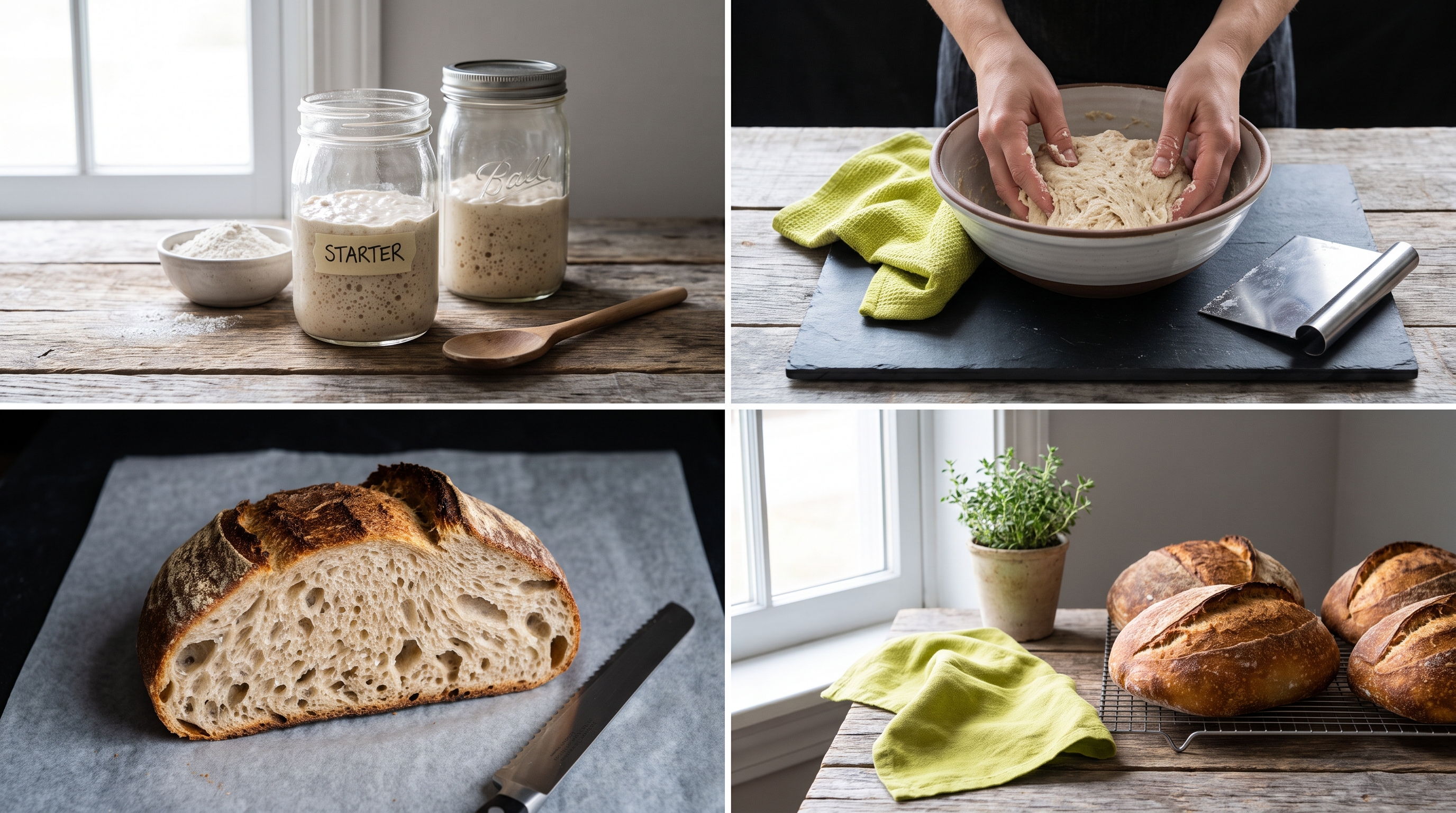
How to Feed Sourdough Starter
Here’s how to feed sourdough starter, in short: pour off most of the old culture, then mix what’s left with fresh flour and water, usually in equal parts by weight. That fresh food gives the yeast and bacteria something to eat, and within a few hours (faster in a warm kitchen, slower in a cool one) the starter turns bubbly and rises. Feed it, let it work, use it while it’s active. That’s the whole idea.
If you already have an established starter (made from scratch, gifted, or bought), the rest of this guide covers the details that actually matter: ratios, flour, water, storage, and how to read your starter instead of a stopwatch.
Why Feeding Matters in the First Place
A sourdough starter is a live culture of wild yeast and bacteria living in a mix of flour and water. Once it’s fed, that population eats through the fresh flour, produces gas, and the whole thing rises and turns bubbly.
Left alone too long, it runs out of food. The yeast slows down, the bacteria produce more acid, and eventually the starter goes quiet and sour instead of active. In most cases a few good feeds bring it right back to life. If it ever stops responding to feedings altogether, instead of just running a little slow, that’s a different situation, covered in more detail further down. It isn’t something to wait out.
That’s why you can’t just make a starter once and forget about it. It’s alive. It needs regular meals, same as you’d expect from any living culture.
The Basic Feeding Ratio
The most common starting ratio is 1:1:1, meaning equal weights of starter, flour, and water. Whatever amount of starter you keep on hand, you feed it that same weight in flour and that same weight in water.
Some bakers use higher ratios, like 1:2:2 or 1:4:4, which means more flour and water relative to the amount of starter kept back. One baker’s account of their own maintenance routine, published on Sourdough Explained, describes how this changes the timeline in practice: a higher ratio (more fresh flour, less existing starter) takes longer to ferment and be ready, simply because there’s proportionally less established yeast doing the work.
That’s useful to know if you’re planning around a schedule. Want your starter ready first thing in the morning? A higher ratio fed the night before might land you at the right window. Want it ready in a few hours? A 1:1:1 feed will get there faster.
Choosing Flour and Water
You don’t need anything fancy here. Strong white flour, sold as bread flour or unbleached bread flour in the US, is what most experienced bakers reach for as a reliable everyday feed, since it gives the yeast plenty of protein and starch to work with.
Water is simpler than people assume. Plain tap water works fine for most starters in most households; it’s only in unusual cases, like heavily chlorinated municipal water, that it causes a noticeable problem. If you’re worried, letting tap water sit out for a while (or using filtered water) is a reasonable precaution, but it’s not a strict requirement for a healthy starter.
One Jar Is Enough
It’s tempting to experiment with several jars, different flours, or starters split off “just in case.” Kate Freebairn at Pantry Mama makes a strong case against this, from her own experience maintaining a starter long-term: keeping multiple jars going is wasteful, uses more flour than you need, and doesn’t make your bread better.
Her advice is to put your energy into one well-fed, well-understood starter. It’ll mature over months, and you’ll get to know its rhythms, which matters more than having backups. If you want to try a different flour for a specific bake, you can adjust a single feeding rather than keeping a whole second culture alive year-round.
The same logic applies to discard: you don’t need to feed your discard or keep it “alive” separately. It’s not going into a loaf on its own; use it in a discard recipe or let it go.
Room Temperature vs. Fridge: Building a Real Schedule
Where you keep your starter changes everything about your feeding schedule.
On the counter, at a comfortably warm room temperature, your starter is active most of the time and typically needs feeding once or twice a day to keep it from running out of food and turning too sour.
In the fridge, things slow way down. One baker’s long-running routine, described in detail on Sourdough Explained, keeps the starter cold and only takes it out to feed before making dough, tied to how often they bake: usually four to five times a week when baking regularly. They also tested keeping it on the counter and feeding twice a day, and found it made no real difference to performance, just more flour used and more discard in the compost bin.
If you bake a few times a week, fridge storage with feeds tied to your baking plan is often the lower-effort option. If you bake daily, counter storage might suit your rhythm better. If your starter has ever seemed sluggish no matter which storage method you use, it’s worth reading through why your sourdough starter isn’t rising before assuming your schedule is the problem.
Guessing at peak timing gets old fast. Autolyse reads your starter's rise as a live curve and predicts the peak from your actual kitchen temperature.
Get Autolyse →How Temperature Changes Your Timeline
Here’s the part that trips up a lot of home bakers: the same feeding ratio won’t peak at the same time in every kitchen.
Fermentation speed is driven mostly by temperature, not a stopwatch. In a warm kitchen, the yeast and bacteria in your starter work through fresh flour much faster than they do in a cool one. A starter fed at a comfortably warm room temperature might be visibly bubbly and rising within a few hours, while the exact same feed in a chilly kitchen can take noticeably longer to reach that same point. Neither one is wrong. They’re just running on different clocks because the room is different.
This is exactly why “feed every 12 hours” or “it should double in 4 hours” style rules fall apart in real kitchens. Your kitchen’s temperature matters more than any fixed schedule. If your starter seems sluggish, temperature is the first thing worth checking before you assume something’s wrong. We’ve gone deeper into troubleshooting a slow or flat starter in why your sourdough starter isn’t rising, if that’s the situation you’re in.
🌡️ Autolyse predicts your starter's peak from your kitchen temperature — free, on every tier. No more guessing off a generic 12-hour rule.
Try Autolyse →This is also the exact problem Autolyse was built to solve. Instead of guessing based on a generic schedule, it predicts your starter’s peak from your actual kitchen temperature, so you know roughly when it’ll be ready instead of checking the jar every hour.
Signs Your Starter Is Ready to Use
Forget the idea that a starter has to double in exactly four to six hours to count as healthy. There’s no fixed clock it has to hit. What matters is that it grows reliably after being fed.
An established starter, fed at a standard ratio in a reasonably warm kitchen, often settles into peaking within a few hours. That’s a typical pattern for a mature starter under those conditions, not a deadline it has to meet. Change the ratio, the flour, or the room temperature, and that window shifts. The real test isn’t the clock, it’s whether your starter grows after being fed, consistently, feed after feed.
Look for:
- A clear rise after feeding, even if it takes longer in a cool kitchen.
- Bubbles throughout, not just on the surface.
- A pleasant, slightly tangy smell, not harsh or overly sour. If you’re not sure what you’re smelling is normal, what your sourdough starter should smell like walks through the difference between a healthy tang and a genuine warning sign.
- Consistency across a few feeds in a row, rather than one lucky rise.
If it’s growing reliably feed after feed, it’s ready, regardless of the exact hour count. A cool kitchen isn’t a failing starter, it’s just a longer clock; see why your sourdough starter isn’t rising for a fuller breakdown of what a slow rise does and doesn’t mean.
When to Worry: Hooch, Mold, and a Starter That’s Gone Quiet
Most starter problems are about timing and food, not danger. A layer of dark liquid on top, often called hooch, is one of the most common things bakers see, and it usually just means the starter is hungry and overdue for a feed, not that anything has gone wrong. If you keep seeing it, what to do about sourdough starter hooch covers how to handle it and tighten up your feeding schedule so it stops showing up.
A starter that’s sluggish or a little flat after a feed is also almost always fixable: keep it on a steady feeding schedule, pay closer attention to temperature, or adjust your ratio.
Mold and unusual discoloration are a different category entirely, and they’re a food-safety issue, not a cosmetic one. This is standard food-safety guidance, not something specific to any one baker’s method: if you see actual mold on the surface, don’t scrape it off and try to keep using what’s underneath. Discard the whole thing and start fresh. The same goes for pink, orange, or black discoloration. It isn’t food coloring from the flour, and it can signal harmful bacteria rather than a harmless quirk. Treat either one as an automatic, immediate discard rather than something to try to nurse back.
A starter that stops responding to feedings altogether is its own case, separate from mold. Starters are fairly resilient and can handle a little neglect, but once one becomes truly inactive, showing no rise and no bubbles feed after feed, the practical advice from experienced bakers is to throw it away and start again rather than trying to nurse it back. That’s especially worth watching for in the first six to ten days of a brand-new starter’s life, when it’s at its most fragile.
So: sluggish or a little flat after one or two feeds, stay on your normal schedule and give temperature and consistency a chance to work. Mold, unusual coloring, or a starter that has genuinely stopped responding no matter how consistently you feed it, discard and start fresh. There’s no in-between fix for those.
Common Feeding Mistakes to Avoid
A few habits quietly undermine an otherwise healthy starter:
Skipping feeds for too long. Starters can handle some neglect, but going too long without food, especially in the first six to ten days of a new starter’s life, can push it toward genuine trouble rather than just hungry.
Storing it somewhere too hot. Yeast doesn’t tolerate real heat well; keeping a starter near an oven or in direct sun can stress it far more than a slightly cool kitchen ever would.
Judging it against a fixed clock instead of its own pattern. As covered above, “it should double in 4 hours” isn’t a rule your starter has to follow. Consistency matters more than speed.
Keeping multiple jars going “just in case.” As Pantry Mama points out, it’s more flour, more discard, and more to manage, without improving your bread.
Confusing sluggish with truly gone. A slow or flat rise after a feed or two is normal and fixable with consistent feeding. A starter that’s stopped responding altogether, or one showing mold or unusual coloring, is a different situation: that’s when it’s time to discard and start over, not keep feeding and hope.
Building Your Own Feeding Routine
There’s no single “correct” schedule, just one that fits how often you bake and where you keep your starter. A few starting points:
- Bake most days? Counter storage with one or two feeds a day is likely simplest.
- Bake a few times a week? Fridge storage, with a feed the night before or morning of your bake, cuts down on wasted flour.
- New starter, first six to ten days? Stick to a steady schedule and watch closely for real warning signs, since this early window is when starters are most vulnerable.
Whatever routine you land on, the two things that matter most are consistency and paying attention to your own starter, not a generic number of hours.
Frequently Asked Questions
How often should I feed my sourdough starter? It depends on where you keep it and how often you bake. On the counter at room temperature, most bakers feed once or even twice a day. In the fridge, feeding is usually tied to your baking schedule rather than a fixed number: someone baking several times a week might feed it four or five times a week, right before each bake, while someone baking less often would feed less often too.
What’s the right flour-to-water ratio for feeding a starter? A common starting point is equal parts starter, flour, and water by weight (a 1:1:1 ratio). Higher ratios like 1:2:2 or 1:4:4 use less starter and more fresh flour and water, which stretches out fermentation time and gives you more flexibility before it’s ready to use.
Can I feed my starter straight out of the fridge? Yes. Many bakers keep their starter cold and only take it out to feed it, right before mixing dough. It doesn’t need to come to room temperature first, though it will take a bit longer to become active if it’s still cold.
Do I need to feed my discard separately? No. You only need to maintain one active jar of starter. Discard doesn’t need its own feedings; use it in a recipe or compost it instead of keeping extra jars alive.
Why isn’t my starter doubling every time I feed it? Timing depends heavily on your kitchen’s temperature, not a fixed clock. A cool room can take noticeably longer to peak than a warm one, and that’s normal, not a sign of a failing starter.
Is it okay to scrape mold off my starter and keep using it? No. Visible mold, or pink, orange, or black discoloration, means it’s time to discard the starter and start a fresh one. These aren’t cosmetic issues; they can signal harmful bacteria, so don’t try to salvage it.
Track Your Starter With Autolyse
Feeding on a schedule is only half the picture; knowing when your specific starter, in your specific kitchen, will peak is what turns feeding from a guessing game into a routine you can plan around. Autolyse tracks your starter’s peak based on real kitchen temperature instead of a one-size-fits-all clock, and logs your feeds and bakes so you can see your own starter’s patterns over time. It’s free to use with one starter and full peak prediction and bake tracking, with a one-time Pro upgrade if you want to manage unlimited starters or multiple flours down the line.