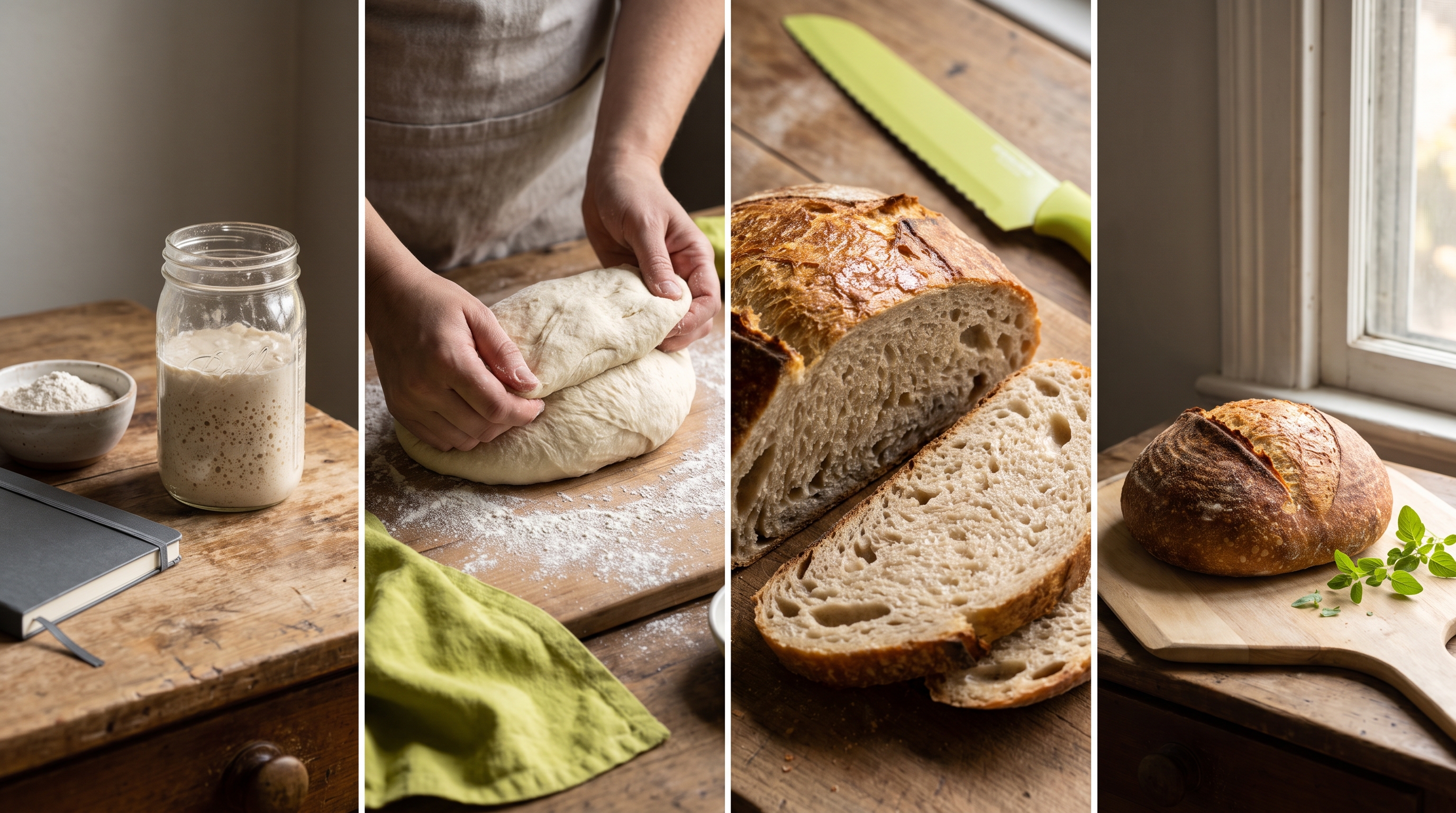
You pull the loaf out, wait (maybe not long enough), slice in, and there it is: a dense, sticky, almost paste-like crumb that clings to the knife. Frustrating, especially after a two-day process.
Here’s the short answer. Gummy sourdough usually traces back to fermentation and baking: under-fermentation, over-fermentation, a weak starter, or under-baking. The most common culprit by far is under-fermentation, meaning the dough didn’t rise long enough before it went in the oven. Two more things quietly shape the result: your kitchen temperature, which drives all of that timing, and slicing the loaf too early, which can fake a gummy crumb on an otherwise good bake. Every one of these is fixable once you know what you’re looking at.
Each cause has a tell, and each has a fix. Here’s how to tell them apart and what to change next time.
What “Gummy” Actually Means
Gummy is a texture problem. The crumb feels wet, dense, and sticky instead of soft and springy. Sometimes it gums up under your knife. Sometimes there’s a compressed, damp streak near the bottom of the loaf.
That texture is telling you something specific: the internal structure of the bread never fully formed or fully set. Either the fermentation didn’t build enough gas and strength to open up the crumb, or the bake didn’t drive off enough moisture and finish cooking the center.
So diagnosing a gummy loaf comes down to two questions. Did the dough ferment correctly? And did the loaf bake long enough? Almost every gummy loaf traces back to one of those two, and often to fermentation.
Cause 1: Under-Fermentation (the Most Common Reason)
This is the big one. As Mandy Clark writes in The Crumb Diaries, a dense and gummy loaf is most often the result of under-fermentation, meaning you didn’t let the dough rest long enough at room temperature before shaping.
Here’s why it makes the crumb gummy. During bulk fermentation, the yeast in your starter produces carbon dioxide, and the dough builds structure to trap that gas. If you cut bulk short, the dough hasn’t produced enough gas or developed enough strength. It goes into the oven tight and underdeveloped, and it bakes up dense with a pasty crumb.
New bakers hit this constantly, and it’s almost always impatience. Sourdough is slow on purpose. It rewards you for watching the dough instead of the clock.
How to tell if you under-fermented
Don’t rely on a set number of hours. Look at the dough itself. Signs that bulk fermentation is actually done include:
- The dough has increased by roughly 50% in volume.
- It feels jiggly when you nudge the bowl.
- You can see bubbles on the surface and around the edges.
- It feels less tacky and more alive than when you started.
If you shaped your dough before you saw most of those signs, under-fermentation is very likely your answer.
The fix
Give it more time. Extend bulk fermentation until you actually see those signs, not until a timer goes off. Prep your dough on a day when you’ll be home to keep an eye on it, and pay attention to how long it takes in your kitchen. That number is yours, and it changes with the seasons.
Cause 2: Temperature Is Driving Your Timing (Whether You Notice or Not)
Here’s the part most “feed it every 12 hours, bulk for 4 hours” advice skips. Fermentation isn’t a fixed clock. It’s a temperature-driven process, and your kitchen temperature quietly controls everything.
Warmth speeds fermentation up. Cold slows it down. Dough sitting in a warm kitchen ferments noticeably faster than the same dough in a cool one. Same recipe, same starter, completely different timeline. Baking educators like King Arthur Baking and The Perfect Loaf repeat “watch the dough, not the clock” for exactly this reason, and it holds up bake after bake.
That’s why a recipe that worked perfectly in summer can give you a gummy brick in winter. In a cold kitchen, the “4 hour bulk” printed in the recipe is nowhere near enough. Your dough ends up under-fermented because you never stretched the time to match the lower temperature. In a hot kitchen, the reverse happens and you sail straight past the finish line into over-fermentation.
If your loaves are gummy and you’ve been following fixed times from a recipe, temperature is very likely the hidden reason. Learn to read your own kitchen instead of trusting a number written by someone baking in a different climate. You can dig deeper into how heat changes your schedule over at Autolyse, which predicts your dough’s timing from your actual kitchen temperature.
Guessing at peak timing gets old fast. Autolyse reads your starter's rise as a live curve and predicts the peak from your actual kitchen temperature.
Get Autolyse →Cause 3: Over-Fermentation
Over-fermentation is the opposite problem, and it can also leave you with a gummy, disappointing crumb.
When you let dough ferment at room temperature for too long, the structure that traps gas starts to break down. The dough goes weak and slack. It collapses easily, spreads out flat, and loses the tension it needs to hold an open crumb. The result can be dense, wet, and gummy in its own way, often paired with a flat, spread-out loaf.
Over-fermentation is easy to hit in a warm kitchen, especially in summer, or when you get distracted and leave the dough far longer than you meant to.
How to tell if you over-fermented
An over-fermented dough tends to look and feel:
- Very loose and slack, without much structure or tension.
- Overly bubbly and then deflated, like it peaked and fell.
- Spread out and flat rather than domed after shaping.
- Sticky and hard to handle, tearing instead of stretching.
The fix
Same principle as before: watch the dough, not the clock. Stop bulk fermentation when the dough has grown by about 50%, gone jiggly, and become less tacky, and don’t wait much past that. On a hot day, that window comes early, so check often. Prepping on a day when you’re home makes a real difference here, because the whole point is catching the dough at its peak instead of after it’s fallen.
Cause 4: A Weak or Immature Starter
Your starter is the engine. If it’s weak, young, or inactive, it simply can’t produce enough gas to leaven the dough properly. You get a tight, dense, sometimes gummy crumb no matter how patient you are with bulk fermentation, because the biology isn’t there to do the work.
This is another classic beginner trap, usually driven by wanting to bake right away. A starter you made last week isn’t ready to raise a loaf yet.
What a bake-ready starter looks like
A starter strong enough for bread should be:
- At least a few weeks old, past the wobbly early stage.
- Consistently rising and roughly doubling after each feeding.
- Reliable, doing the same thing feeding after feeding, not just once by luck.
One thing worth clearing up: a healthy starter does not have to double in a fixed 4 to 6 hours. Time to peak depends heavily on temperature. A cool kitchen can easily double that time, and your starter can be perfectly healthy while taking longer. Judge it by whether it rises and peaks reliably, not by a stopwatch.
If your starter isn’t rising the way it should, that’s worth fixing before you blame the bread. Our guide on why your starter isn’t rising walks through the usual causes, and if you’re still building strength, how to feed your starter covers ratios and timing. Brand new to all this? Start with how to make a sourdough starter and give it a few weeks before you expect big loaves.
🌡️ Autolyse predicts your starter's peak from your kitchen temperature — free, on every tier. No more guessing off a generic 12-hour rule.
Try Autolyse →Cause 5: Under-Baking
Sometimes your fermentation was fine and your starter was strong, but the loaf still comes out gummy. In that case, look at the bake itself.
If a loaf comes out of the oven too early, the center hasn’t finished setting. Bread continues cooking and firming right up to the end of the bake, and pulling it early leaves a damp, dense, gummy interior even when the crust looks done. A dark crust can fool you into thinking the inside is ready when it isn’t.
How to tell if you under-baked
- The gumminess is worst in the center or near the bottom, not throughout.
- The crust colored up fast but the loaf feels heavy for its size.
- Tapping the bottom gives a dull thud instead of a hollow sound.
- The center still feels damp and pasty when a fully baked loaf would feel set and dry.
The fix
Bake longer, and don’t trust crust color alone. Give the loaf more time, and tent it with foil if the crust is getting too dark before the inside catches up. The most reliable check is internal temperature. Guides like The Perfect Loaf and the baking team at Serious Eats recommend using a thermometer rather than pulling the loaf on looks, and King Arthur Baking points to an internal reading in the range of about 205 to 210°F (96 to 99°C) for a crusty, lean loaf like sourdough. Wait until the center reads fully hot before you take it out. When you pull it matters, and so does what you do next.
Cutting Too Early: The One That Fools Everyone
This one isn’t a fermentation or baking fault at all, but it fools a lot of bakers, so it’s worth calling out on its own.
A loaf is still finishing as it cools. The starches keep setting, and moisture keeps redistributing through the crumb. Slice into a hot loaf and you release all that steam at once, which can leave the crumb feeling wet and gummy even when the bake was actually fine.
The fix costs you nothing but patience. Let the loaf cool completely before you cut it, ideally a couple of hours. Warm bread is tempting, but cut too soon and you can turn a perfectly good bake into a gummy-seeming one for no reason.
How to Diagnose Your Own Gummy Loaf
Put it all together and you can usually pinpoint the cause with a few questions:
- Was the whole crumb dense and tight? Likely under-fermentation, or a weak starter if your bulk timing looked right.
- Did the loaf spread out flat and feel slack before baking? Likely over-fermentation.
- Was the gumminess mostly in the center or bottom? Likely under-baking.
- Did you slice it while it was still warm? That alone can do it.
- Did you follow fixed recipe times in a hot or cold kitchen? Temperature probably pushed you into under- or over-fermentation.
Change one variable at a time on your next bake. If you fix everything at once, you won’t know what actually mattered, and you learn the most by isolating a single change.
A quick honest note. I’m a fellow baker, not a food scientist, so I lean on baking-science sources like King Arthur Baking and Serious Eats for the mechanics and on watching a lot of dough for the rest. The fermentation signs and the temperature effect above are the ones that hold up bake after bake, and you can read more about how I track it all at Autolyse.
The One Habit That Fixes Most Gummy Loaves
If you take away one thing, make it this: stop baking to a fixed clock and start baking to the dough.
Watch for the real signs: about 50% growth, a jiggle, visible bubbles, a less tacky feel. Adjust your timing to your kitchen’s temperature instead of copying a number from a recipe written somewhere warmer or cooler than your home. Make sure your starter is genuinely active first. Then bake fully and let the loaf cool before you cut.
Do that, and gummy crumb stops being a mystery. It becomes a signal you can read, and usually fix, in a single bake.
Frequently Asked Questions
Is gummy sourdough undercooked or under-fermented?
It can be either. A pasty, dense crumb throughout usually points to fermentation problems, while a wet, sticky streak near the bottom often means the loaf came out of the oven too early. Check your bake time and internal signs before assuming it’s fermentation.
Can I fix a gummy loaf after it’s baked?
Not really. Once it’s baked, the crumb is set. You can toast slices to dry them out and make them more pleasant to eat, but you can’t undo under-fermentation or under-baking. The fix is in your next bake.
Does cutting bread too early make it gummy?
Yes. Sourdough keeps setting as it cools because the starches continue to firm up. Slicing a hot loaf releases steam and can leave the crumb feeling wet and gummy. Wait until it’s fully cool, ideally a couple of hours.
Why is my crumb gummy even though the loaf rose well?
A good rise in the oven doesn’t guarantee full fermentation or a fully baked interior. You can get decent oven spring and still have an under-baked center, or dough that over-fermented and lost its structure. Check your bake time and your bulk fermentation signs.
How does kitchen temperature cause a gummy crumb?
Temperature controls how fast your dough ferments. A warm kitchen speeds it up and a cool one slows it down. If you follow a fixed clock instead of watching the dough, you can easily under-ferment in a cold kitchen or over-ferment in a hot one, and both can turn out gummy.
Can a weak starter cause gummy bread?
Yes. A young or sluggish starter doesn’t produce enough gas to properly leaven the dough, which leaves you with a dense, tight, sometimes gummy crumb. Make sure your starter is active and consistently rising before you bake with it.
Track Your Starter With Autolyse
Since most gummy loaves come down to fermentation timing, and timing is really about temperature, Autolyse predicts your dough’s peak from your actual kitchen temperature instead of a one-size-fits-all clock, so you know when bulk fermentation is genuinely done. It’s free for one starter with full temperature-aware peak prediction and complete bake tracking, and a one-time $6.99 Pro upgrade adds unlimited starters, the baker’s math calculator, and multi-flour blends if you want them. Read the dough, match the temperature, and gummy crumb stops being a guessing game.